.png?width=1133&height=1536&name=BOSKA-blog-image%20%E2%80%93%201%20(1).png)
A strong foundation in DTC, built over time
BOSKA’s shift to DTC didn’t happen overnight. It began in 2019 when the company decided to move beyond retail and start selling directly to consumers through its own webshop. “Direct-to-consumer was only about one percent of our total revenue back then. Now it’s almost 40 percent,” Pascal said.
This growth came from a combination of strategy, investment, and partnerships. BOSKA worked closely with Code’s team to build its Shopify-based storefront. At the same time, it expanded its reach through marketplaces, which complemented their retail presence and offered fast access to international markets. As Pascal put it, “Retail is still part of our DNA, but online has given us a new way to grow.”
BOSKA’s long-standing success in B2B helped provide a stable base, while digital gave them new levers to pull. But this growth also required a mindset shift. “With DTC, you’re not just selling products. You’re building customer relationships and shaping their experience from end to end.”
Marketplaces: Growth channel and learning ground
BOSKA had already been working with platforms like Amazon and Bol.com as a vendor. But the vendor model left them with little control. “We didn’t know who was buying, how the product was priced, or how it was being presented,” Pascal explained.
Over time, they expanded to include all Amazon platforms across Europe, as well as in the United States, Canada, and Mexico. Bol.com remained key in the Dutch market, and regional players like Kaufland and Walmart also became part of the mix.
Marketplaces proved to be more than just sales channels. They became testing grounds for new regions and products. “Amazon makes it relatively easy to launch in a new country. It helps you validate whether there’s demand before investing in local logistics,” Pascal said. This was also the case in the UK, where BOSKA launched via Amazon and saw enough traction to activate boska.com for that market.
Still, marketplaces come with limitations. “It’s all transactional. Customers are buying based on reviews and rankings. We don’t know who they are, and we can’t build a relationship.” That’s one of the reasons BOSKA is now working to bring more of those customers to its own platform.
Logistics: Choosing the right model for each channel
Handling logistics efficiently is one of the main reasons BOSKA has been able to scale. The company uses fulfilment by Amazon (FBA) and Logistics via Bol (LVB) for its best-selling products, while longtail items are fulfilled by a 3PL in the Netherlands. This hybrid model allows them to adapt to different markets and customer needs.
Pascal highlighted how important it is to play to your strengths. “We briefly considered handling DTC logistics ourselves, but it’s a completely different business from B2B fulfillment. One cheese slicer in a gift box is not the same as shipping pallets.”
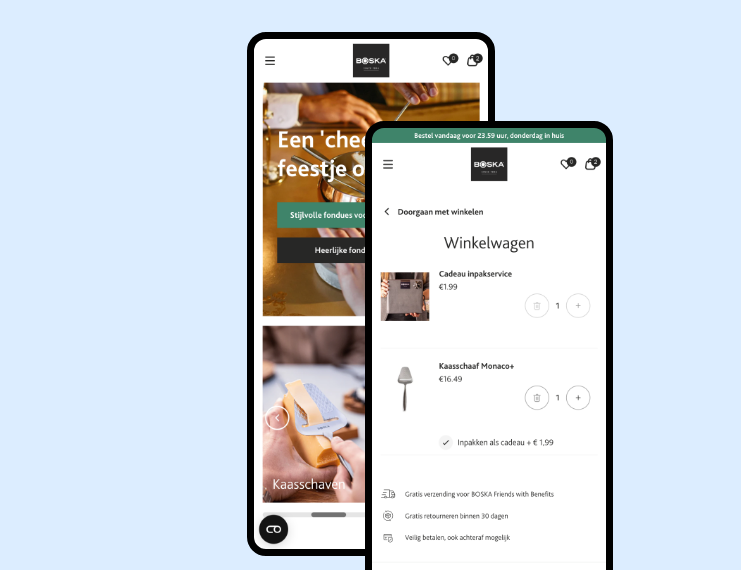
Their 3PL setup also allows for more personalisation. Gift wrapping and handwritten notes are available for orders on boska.com, which helps differentiate the DTC experience. “Many of our products are given as gifts. It matters that the unboxing feels thoughtful.”
Automation has been critical too. In the early days, many orders were processed manually. Today, they use ChannelEngine as a marketplace integrator to automate order routing and fulfillment across marketplaces. “You need that efficiency to keep operations scalable. Without it, the cost structure becomes unsustainable, especially for lower-priced items.”
Building loyalty with first-party data
One of the biggest challenges with marketplaces is the lack of customer data. Without insights into who’s buying their products, BOSKA struggles to build retention and understand buyer behavior. That’s why the team is now investing in ways to gather more zero- and first-party data through their own channels.
Packaging now includes QR codes that invite customers to visit boska.com. There, they can find recipes, inspiration, and product registration tools. It’s one way of bringing marketplace and retail buyers into their ecosystem. “We sell millions of products a year, but a relatively small percentage of those customers come through our webshop. We want to change that.”
A loyalty program is also in development. The idea is to reward customers not just for purchases, but for engagement and interaction. Even if someone received a BOSKA product as a gift or bought it in a store, they could still sign up and start collecting points. “That’s how we bring people into our world, even if the first touchpoint wasn’t direct.”
The next step is segmentation and personalisation. BOSKA already uses email marketing automation, and they’re now exploring a customer data platform to go further. “Eventually, we want every email and homepage to feel tailored. Not everyone should see the same content.”
What’s ahead for BOSKA
This year, BOSKA is consolidating its multiple Shopify stores into one environment using Shopify Markets. That will allow them to manage all regions from one platform while offering localised experiences. The UK will be relaunched as a full market, supported by local fulfillment and an updated customer journey.
→ Are you looking to expand cross-border, or migrate your international store to Shopify? In this blog we’ll help you determine which Shopify setup works best for your business.
A key part of this future strategy is product personalisation. The company is adding features that allow customers to personalise gifts with names, messages, or symbols. “It’s something marketplaces can’t offer. It’s a reason to come to boska.com instead.”
Pascal’s team is also growing. They now have a dedicated marketplace manager and someone to take full ownership of the webshop’s growth. “We’ve seen what focus on marketplaces can do. Now we want that same attention on our own platform.”
Advice for brands balancing DTC and marketplaces
For brands that are already strong on marketplaces and considering a DTC push, Pascal’s advice is clear: create focus. “The past few years we focused on marketplaces and B2B, and it worked. But it also meant our own webshop got less attention. You need to dedicate time, resources, and people. Growth will follow.”
His approach is pragmatic, but also hopeful. By building the right tech stack, offering a more personal experience, and using data the right way, BOSKA is creating a strong DTC channel that supports its other strengths.
Looking for a Shopify partner?
As BOSKA’s e-commerce agency, Code worked closely together to build a scalable Shopify store. Feel free to reach out if you’re looking for a Shopify partner to support your next step.
Subscribe to future Code Commerce Club podcast episodes
Code Commerce Club is the podcast where you learn how to achieve more e-commerce success with your brand. Hosted by Robin Huizing, produced by Code and powered by Shopify. Listen to the full conversation with Pascal Verheul in the Code Commerce Club podcast on Spotify or Apple.
Would you like to hear more open conversations with successful e-commerce managers? Subscribe to our newsletter to stay up to date with new podcast episodes, or simply subscribe (please leave us a review!) in your favorite podcast app.